The Krishnajina as Yagnopavitham

For starters this post is not about any Yagnopavitham. It is about a very particular one – the one that is called Krishnajina. Let us see if you can make out what it is from these images.

Let us take the Brahma ( Aihole region, 7th C CE) currently on display in the Prince of Wales Museum, Mumbai ( photo from various websources – apologies for image quality – would welcome readers from Mumbai to take a better shot to update this post)


In Iconographical terms it is the Skin of a black buck antelope !

Disclaimer:
“The use of animal hide to aid in Meditation and religion is outside of the scope of this post and please refrain from commenting on those lines. This is just a study on Iconography and providing samples to aid further thought.”

It became interesting when Saurabh Saxena did this amazing post on Deogarh and the much debated ‘ Nara Narayana’ idenfication.

Study the person seated on the left closer.

Now is the hide an apparel / clothing or is it the Krishnajina used as the sacred thread.

The answer to the question may lie in this Torso of ” bodhisattva” currently in the V&A Museum

You would agree that there can be no better depiction of the Krishnajina than this masterpiece – such brilliant workmanship.

10669

More study must be done on this for sure.

Controversial Sculpture Series – Part 3 – Kankalamurthy

We continue this controversial series with another highly controversial sculpture – Kankalamurthy. Lets look at the Iconography first before heading into the murky plots – he is quite often confused with his Bhikshadanar form not without reason, for they appear quite similar but for some key differences.Take these two from Gangai Konda Cholapuram.

The first and most obvious one is the presence and absence of clothing. Bhikshadanar is naked with a few snakes on him, while Kankala is shown fully dressed. The texts do mention however that his upper garment must be the skin of a horse or an ass, which he should wear with the hairy side appearing outside and lower garment made of threads of the hemp and when worn
it should not descend below the knee. ( notice the when worn ! ). Both wear thick wooden clogs /slippers.

The second obvious difference is in the headdress. Kankala has a Jatamakuta ( hair that is worked to form a crown) while Bhikshadana has a Jata Bara ( more like a wandering mendicant’s unwashed thick locks brushed back!) or even a Jata Mandala ( the same like jata bara but the hair kind of radiates to form a circle!).

Hair style differences …thanks for art

However, this hair dress part seems to be not followed 100% with some combination sculptures, meaning there are a few Bhikshadanar with Jatamakuta – maybe the sculptor tried a two in one upsize combo.

But there are some very important differences that enable us to clearly distinguish the two.

Watch what Shiva is holding in his lower left hand. If it is a skull cap begging bowl ( we will come to the story shortly) – it is Bikshadanar and if he is holding a particular variety of drum called a Dhakka, it is Kankala.

Further, the lower right hand of Bikshadanar is feeding his antelope, while that of Kankala must be beating the drum with a stick ( called bana). The second right hand of Bikshanda holds a damaru above shoulder height, while that of Kankala is feeding the antelope. Now we have a peculiar problem in the Gangaikonda Cholapuram sculpture – the Kankala has 6 hands and the front ones are broken but then you can see that only the second right hand is feeding while the third is bent up holding a coiled snake.

The upper left hand of both hold a staff but herein comes the most clinching evidence. The staff is no ordinary staff for the Kankala murthy. Kankala – is termed as a skeleton or corpse. The skull cap in the hand of Bikshadana is the plucked head of Brahma – the popular Lingothbava connection. However the Kankala connection gets more sinister with many a variant being sung about. Its 100% controversial with the most common version – stating that Shiva as Bairava being barred entry by Viswaksena – the head of Vishnu’s staff and an enraged Bairava spearing him with his trident and carrying his lifeless body impaled on it. Sounds gruesome – but believe me this is the most mildest version that i could post. The others versions talk of the spinal cord etc. But the ending kind of brings some parity between the two Gods – by saying Vishnu infact helps Shiva redeem himself from the curse etc ( other versions say it was Lakshmi !)

To get back to Iconography of the supporting cast of the Kankalamurthy form , below passage from Sri Gopinath Rao’s Elements of Hindu Iconography will be of interest

“The Kankalamurti should be surrounded by a number of women and the bhutaganas (goblins) represented variously as dancing, singing and in other attitudes ; one of the bhutas should carry on his head a large vessel for storing in the food received in alms and be situated on the left of Siva. Of the women who surround Siva some should appear to be completely possessed of irrepressible love for him, some eager to embrace him, some others blessing him, while still others serving in his vessel food ladled out from another with a spoon. Out of lust for Siva the clothes of the women should appear slipping down their loins.. There should also be hosts of rishis, devas, gandharvas, siddhas and vidyadharas everywhere around Siva, with arms crossed on the chest in the anjali pose. The god Vayu should sweep the streets before Siva, Varuna should sprinkle them with water, the other devas should shower flowers on him, the rishis should praise him by repeating the Vedas, Surya and Chandra should carry umbrellas over his head and the celestial musicians Narada and Tumburu should sing songs to the accompaniment of musical instruments.”

When we were in Thirukkurungudi last December, we were fortunate that the Gopura was undergoing extensive upkeep and hence we could climb both the outside ( a little scary and spiderman like ) and also on the inside. It was the last place we expected to find a relief sculpture of Kankalamurthy confirming to iconographic cannons as above !

Must have been a very brave sculptor to attempt this.

You can apply the specifications from above perfectly to this sculpture.

What is a puzzle however is what is shown on the other end of staff. Looks like a reptile

Maybe it is a contingency against him not being so successful in his efforts to secure his breakfast, which is not surprising considering the fact that he has a corpse dangling behind him.

It is important to read these in context to life and culture of those days. What may appear in today’s context to be stupid or ridiculous might have been the norm them. While reading a paper on Self sacrifice came across this interesting reference where ” Viran and Narayana – twin brothers who served under Parantaka Chola I, simply cut off their own heads to demonstrate how they cut off the head of Vikkalan, the King of Nellore’

However, as usual all ends well – with Viswaksenar resurrected and going back to his duties and Shiva regaining his benevolent form .

A brave 7th C CE Dog remembered !

Quite often we tend to think of ancient languages, scripts etc especially tamil to be confined only to palm leaf manuscripts or to temple inscriptions. There is another equally important source to study the evolution of the script but their main purpose was something more gallant. Hero Stones or Nadukkal are found not confined only to Tamil land but are spread all over India, they are raised to remember the bravery of a fallen solider or even a villager – usually who fought to save the village livestock from cattle raiders,or the village persay from enemy soldiers or even from wild animals.

I was fortunate to stumble across one very unique stone not in person, but when i was interacting with the great scholar Sri. Michael Lockwood, while searching for a pallava inscription, came upon his reference of a Hero stone in Chengam – Chengam Nadukarkal No 13 to be precise.

After the release of the recent movie Aravaan, there is renewed interest in such hero stones and their specific purpose. It would be interesting to read what is in this particular stone and why is it so unique.

For starters, the text is in two blocks around the central relief. The period assigned is the 7th C CE, Pallava period, the script used is Vatteluthu.

The portion on the top comprising 9 lines refer to the hero holding the bow and knife depicted below.

Text courtesy : Tamil Nadu Department of Archaeology and Mr Michael Lockwood

Quote:

1. Ko – Visaiya
2. Mayindira-parumarku
3. muppattu nangavadu [|*] Vanako-
4. arasisaru marumakkal Porrokkai-
5. ar ilamagan Karundevakkatti tan-
6 nerumai-p-
7 puratte va-
8 di patta-
9 n kal [||*]

Meaning – : ” Records the death of Karundevakkatti, the younger son (ilamagan) of Porrokkaiyar who was the nephew ( marumakkal) of a Bana Chieftain.’

The portion to the side is what is interesting. The ancients did not stop with recording the death of the the hero, they go on to honor another…

10 [koviva] – [ read: Koriva – by Mr Lockwood]
11 n-n=ennu
12 n-nay i-
13 ru kalla-
14 nai-k-kadit-
15 tu-k-kattiru-
16 ndavaru [||*]

Meaning: “Also mentions that a dog named Ko[ri*]van bit two thieves and kept watch.”

Images courtesy: http://tamilnation.co/heritage/dolmens.htm
and http://www.tnarch.gov.in/epi/ins11.htm

Michelangelo’s David Vs Nellaiappar Arjuna – part 2

In part 1, we compared David poised to strike with the sculpture of Karna in Nellaiappar temple. We continue the narration today by viewing the scene from the view of Protagonist of the battle – the mighty Arjuna ( my personal preferences are with Karna though) – to recap we are in day 16 of the great battle @ Kurukshetra. Previously having sat out the great battle for 10 days, Karna being kept out by the guile of the great Bhishmar , has set his eyes to slay Arjuna – but from day 11 to 16 – the battle flows with the Pandavas gaining the upper hand thanks mostly to the Krishna. Krishna is said to have praised Karna in front of Arjuna thus

“Do not. O mighty-armed one, disregard Karna, that ornament of battle! Karna is possessed of might. He is proud and accomplished in weapons. He is a Maharatha. He is accomplished (in the ways of battle) and conversant with all modes of warfare. He is also well-acquainted with all that suits place and time. What need is there of saying much? Hear in brief, O son of Pandu! I regard the mighty car-warrior Karna as thy equal, or perhaps, thy superior! With the greatest care and resolution shouldn’t thou slay him in great battle. In energy he is equal to Agni. As regards speed, he is equal to the impetuosity of the wind. In wrath, he resembles the Destroyer himself. Endued with might, he resembles a lion in the formation of his body. He is eight rathis in stature. His arms are large. His chest is broad. He is invincible. He is sensitive. He is a hero. He is, again, the foremost of heroes. He is exceedingly handsome. Possessed of every accomplishment of a warrior, he is a dispeller of the fears of friends.”

Lets us see the classic faceoff between the two.

Now, Arjuna knows that the Nagastra has been taken up by Karna, let us see his expression ( not to mention his long beard and it seems to be tied up in a knot at the end as well)

The overall poise is that of someone who knows that he has no answer to the bolt that is going to be hurled at him, his left leg is slightly back and his body tilted a bit – on the back foot.

You can compare the torso of the two, and you can see that Arjuna’s chest is relaxed.

Compare it to the torso of Karna, with its bulging chest and exposed ribs

Yet, Arjuna has an arrow out of his quiver in his hand. Maybe, he is confident that Krishna would find a way to save him !

The portrayal is useful to compare against David.


Ofcourse, the detailing of the knee caps of the ligament in hard granite of Arjuna is outstanding

For such a colossal work in stone, the way he holds the arrow shaft , the ribs of the feather on the shaft, the posture of the fingers and the detailing of the nails !

Definitely time stands still as the master sculptor sculpted his scene in stone.

Michelangelo’s David Vs Nellaiappar Karna – part 1

In the art world some names are uttered with a deep reverence – Michelangelo di Lodovico Buonarroti Simoni is one of them – An artist par excellence who excelled in painting, sculpture and architecture. I was fortunate or rather serendipitously lucky to read more about the great man and his true love of carving marble in the book The Agony and Ecstasy . It had been a long and eventful Pandya Naadu tour for me and Arvind and as we parted – the hired taxi dropping him off at Nellai Railway station and me at the Nellai bus stand, giving me an hour and a half to kill and a bone jarring bus ride to Coimbatore. The Old book shop outside the railway station did not look promising, as it mostly had used school and college books ( and i had already had enough of them year back). He managed to take out couple of English Novels both of which has long lost their front covers, but the inside page was clear – The Agony and the Ecstasy: A Biographical Novel of Michelangelo – by Irving Stone. I asked for the price and i think the owner was more than happy to get rid of it, if i had persisted he would have given it to me for free !

We had just come out of the famed Nellaiappar temple after about half a day of looking at the sculptures, which are still today quoted by many to be the most beautiful sculptural works – along with their sister works in Krishnapuram. As i got immersed in the book over the next couple of days, I grew to know the sculptor in Michelangelo, his single minded drive to carve marble, his thirst to be become number one – his trysts with Leonardo Da Vinci with more than its share of ‘ healthy’ competition. I read in rapt attention at how he took on an abandoned and already worked block of marble – the massive block of white marble had been quarried from the famed Quarry in Carrara , high in the Apuan Alps of Tuscany – specially for the great Donatello to be executed maybe via his pupil Agostino in 1464 CE. But the project was shelved with the demise of Donatello in 1466. Ten years later they tried to resurrect it with a contract to Rossellino but it never went forward. The block was possibly worked on and blocked out – maybe cut / drilled at the bottom to shape a foot. But then it lay in that state exposed to the elements for another 25 years – till 1501 CE ! Infact in 1500, an inventory of the cathedral workshops described the piece as “a certain figure of marble called David, badly blocked out and supine.”

The contract was re floated and against ( arguably) competition from Leonardo, Michelangelo won the commission. He breaks convention or rather the earlier version of David by Donatello and carves the now immortal David.

We are lucky that some of his rough sketches survive to this day and we can catch a glimpse of how the great artist tried to solve the problem of a tall block of marble.

The story was much popular then as well but it is clear that initially he went with the popular depiction of showing the slain head of Goliath underneath David’s feet. But then, I guess, he wanted his work to infused with more life. So he chose to depict David facing up to the Giant and caught him in a moment, where he contemplates taking on this task and breaking tradition from not portraying after the slaying.

For starters, the finished work stands all of 17 feet – if you understand how a rough block of marble is worked on, you can imagine the size of the original block.

That the great artist completed the task in just 3 years – 1501 to 1504 is itself mind boggling, but as we take time to study it in detail, it is truly astounding.

All David’s images in this posts are courtesy the internet, wikipedia – too many sources to individually thank but one big thanks to google.

To add to the complexity is the fact that this is a free standing sculpture and the sculptor would have to leave enough of the material at the feet as he reduced the weight from the top,else the weight of the load on top would crumble the legs. He must have blocked out the major limbs and steadily worked top down calculating the centre of gravity and weight distribution. And then the detailing and emotion, the sureness of form, the study of the human anatomy, limbs, nerves, bones, ribs, knee caps, ligaments and tendons moving over muscle and flesh.

Many scholars and experts have still argued about the expression on his face, but to me the entire frame is in suspended animation – his right hand holding the stone, the left hand with the sling, as he ponders his destiny, there seems to be a certain apprehension as he weighs his own skill and strength, a minor trepidation that he might not win and that is the very pinnacle of sculpting.

It slowly dawned on me that i had seen a similar scene that very day – of two rivals facing each other in battle. In the famed corridors of the Nellaiappar temple – is a rare sculpture of Karna – the eldest son of Kunti, elder to 5 Pandavas, but forced into the enemy camp by evil fate – yet the greatness in him, the Son of the Sun God, he who never sent back anyone from his door empty handed – even giving up his invincible body Armour and Ear rings in alms to Indra. He who fought for the sake of friendship against his own brothers and he who wanted to kill his own brother Arjuna.

Karna knew that the only weapon he had that could fell Arjuna was the Naga Astra – for which Arjuna had no counter, for it was the very personification of Awasena ( the snake – son of the Snake king, the only one who escaped the burning of the Khandava forest by Arjuna and Krishna and he was out to avenge his mother !)

The pillar sculpture is of massive proportions – with Karna sculpted to be about 12 feet, but is not free standing ofcourse – but carved out of hard granite with other sculptures in the round and the weight bearing load of the roof above supported by the pillar..

The period of this sculpture must be around the 16th -17th C CE – Nayakas – characterized by the slightly excessive ornamentation and distinctly over emphasized features. .

Here too the sculptor has chosen a moment in time in the action – Karna has drawn his bow with his left hand and is taking out the Naga Astra shown in its snake form. His facial features are shown as a confident man, he who knows that his opponent has no answer to his bolt, that the defining moment of the battle has come and he is going to be crowned as victor – sung in the exalted annals of history, as the one who slay Arjuna and the undisputed King of Archery in the world.

Now to consider, not as a comparison, but just as a study – the understanding of the human form by the Indian sculptor. The hard stone has been carved to depict the ease with which he is holding the bow, almost like a caress – you can make out the stone that has been removed between the finger holds and the beauty of the nails, you can even see a slight bulge of the muscles in the elbow !

He seems to taking a step back or moving his right leg to anchor his body, as he prepares to discharge the bolt. The resultant elevation of the knee caps and the bulging out of the ligaments on the side of the knee, are clearly seen.

He seems to be inhaling as he prepares to draw his bow, forcing his rib cage to expand thereby trusting up against the skin of the chest ! We will see the contrasting posture of Arjuna in the subsequent post.

Such a great work in stone. The intention of this post was to showcase the two works – not to show which is better or draw comparisons – but just that one is celebrated across the world while the other doesn’t even get a casual glance from the thousands who walk past.

We will see the contrasting posture of Arjuna who is going to face this bolt in part 2 of this post !

Treasures of Cham (vietnam) sculpture – part 1

Not many of us would have heard the name Champa / Cham. It is a glorious kingdom that prospered in modern day Vietnam in and around the centre of the country closer to present day Danang – with their origins as early as 7th C CE. The early history was predominantly Saivite and it is interesting that the cities were names Indrapura, Amaravati, Panduranga, Vijaya etc.

The Hindu art of the Cham is really interesting, but very rarely found outside of vietnam. Much of the treasures have not survived the pressures of conflict but what remains is a real treasure. Most of them are housed in the Museums in Saigon ( Hochiminh city) and Danang. The popular forms are a profusion of Linga, Mukalingas, Sayana ( sleeping) Vishnu and ofcourse Ganesha.

Today, we see the first part of this series on Cham sculptures, with a magnificient early Ganesha – dated to the early period of Cham art – 8th C CE.

For starters the time line of Cham artifacts are split in the following styles ( the names are the regions from where the art of the periods were found)

My Son E1 (7th to 8th century CE)
Dong Duong (9th to 10th century CE)
My Son A1 (10th century CE)
Khuong My (first half of 10th century CE)
Tra Kieu (second half of 10th century CE)
Chanh Lo (end of 10th century to mid-11th century CE )
Thap Mam (11th to 14th century CE)

The Ganesha is carved out of sandstone and the most characteristic features are the attributes. Sadly, only one of the hands has survived but he holds a very interesting object in it

For a second we were wondering what it might be, before we realised that it was our humble corn, complete with the peeled skins hanging down.

It was also interesting to note that he had a Naga ( snake) yagnopavitha – the sacred thread.

There are also remnants of ornamentation seen on the arm and also the simple crown. The detailing and size of the toes/ feet, the waist cloth etc are also beautiful. There seem to be some provision to insert the eyes ( precious stone?).

Thanks to master artist Mr. Srinivas of The Chroma Academy, we get a chance to recreate the sculpture.


The Cham sculpture however is distinct and different from the Ganesha’s we see ( contemporary period 8th C CE) in South India.

It would be interesting to study it more, and for those interested to pursue one of the very early Ganesha forms is the Terracota Ganesha escavated from veerapuram ( Kurnool district in AP) ( courtesy : Ganesh: studies of an Asian god
By Robert L. Brown) – dated to 2nd C BCE !!

There is lot more to come in this series and next up will be this very very interesting and unique panel

Photos Courtesy : Mr Wasanta Fernando
Vietnam History Museum Address:
Nguyen Binh Khiem Street, District 1, Ho Chi Minh City.

An Unique ‘Naga’ Temple in Batam

Its not often we get a chance to visit offbeat sites and when our Tour guide Dhani mentioned about a Hindu temple in Batam, ‘ we ‘ pushed the shopping agenda to make way for the famed ” Naga” temple of Batam. Nestled amidst dense vegetation, the first glimpse was the typical Balinese Gopura. The structure immediately brought to mind Dr. Kudavoil Balasubramaniam’s book “Koyil Kalai Marabhu’ where he had illustrated these very structures – Hindu temple Gopura’s typically signify the ritual of passing through an entrance of fire, thereby purifying the soul – and that is what evolved to present day towering Gopuras – however, the vestigial links with the original concept are still seen strewn across Indonesia.

Just we passed through, we were pleasantly surprised to see a perfect modern temple to our side – Sri Tripurasundari temple, complete with a priest from Devakkottai. He did mention that he was still preparing for pooja and advised us to go visit the shrine farther away and comeback to see his !

A stiff 100 m walk and we were faced with a steep flight of steps ending in a magnificent entrance Gopura,

The time period/dates of this structure are still unclear but my joy knew no bounds when we were greeted by a pair of superb doorguardians and an equally superlative lintel of Garuda.

The door guardians seems to part of a larger arrangement while the Gopura and the lintel persay seemed more recent works.

As we entered the temple, we were greeted by a very ‘Indian’ Ganesha. You will understand why i mention so shortly.

The next view blew us away. Such a towering sight , considering that we had already climbed a decent height – but this structure was massive and being hidden from view from the outside the effect was doubly strong.

We were certainly not expecting to see such a structure. There were two cute ‘local’ ganesha’s different yet complete with the attributes – the axe, the flower, the mothahagams and suvadis !

What was more unique is the depiction of the various ‘snakes’ on the mount !

We couldn’t quite makeout the central theme and decided to go around to inspect more.

Seeing the massive curls of the snake coil around the structure, a realisation occurred that this could be the depiction of the churning of the Milk ocean for Amrit. The claws and the tail were a definite clincher. ( here is our Tour guide Mr Dhani – just to give you an idea of the scale !)

So when we moved to the front again they all began to fall in place.

The Bottom dragon face was infact that of a turtle – of Vishnu balancing the mount as turtle Kurma! and the churning rope being the snake Vasuki ( the dragon head on top)!

Usually the focus would be the Devas adn the Asuras holding the two sides and churning, but they have been done away with totally, instead focussing our attention entirely on the main act !

What made the entire complex so wonderful was the design, of presenting it on a small cliff with this artificial mount. The interesting part was the depiction of Garuda at the back and also a swan / bird above him.

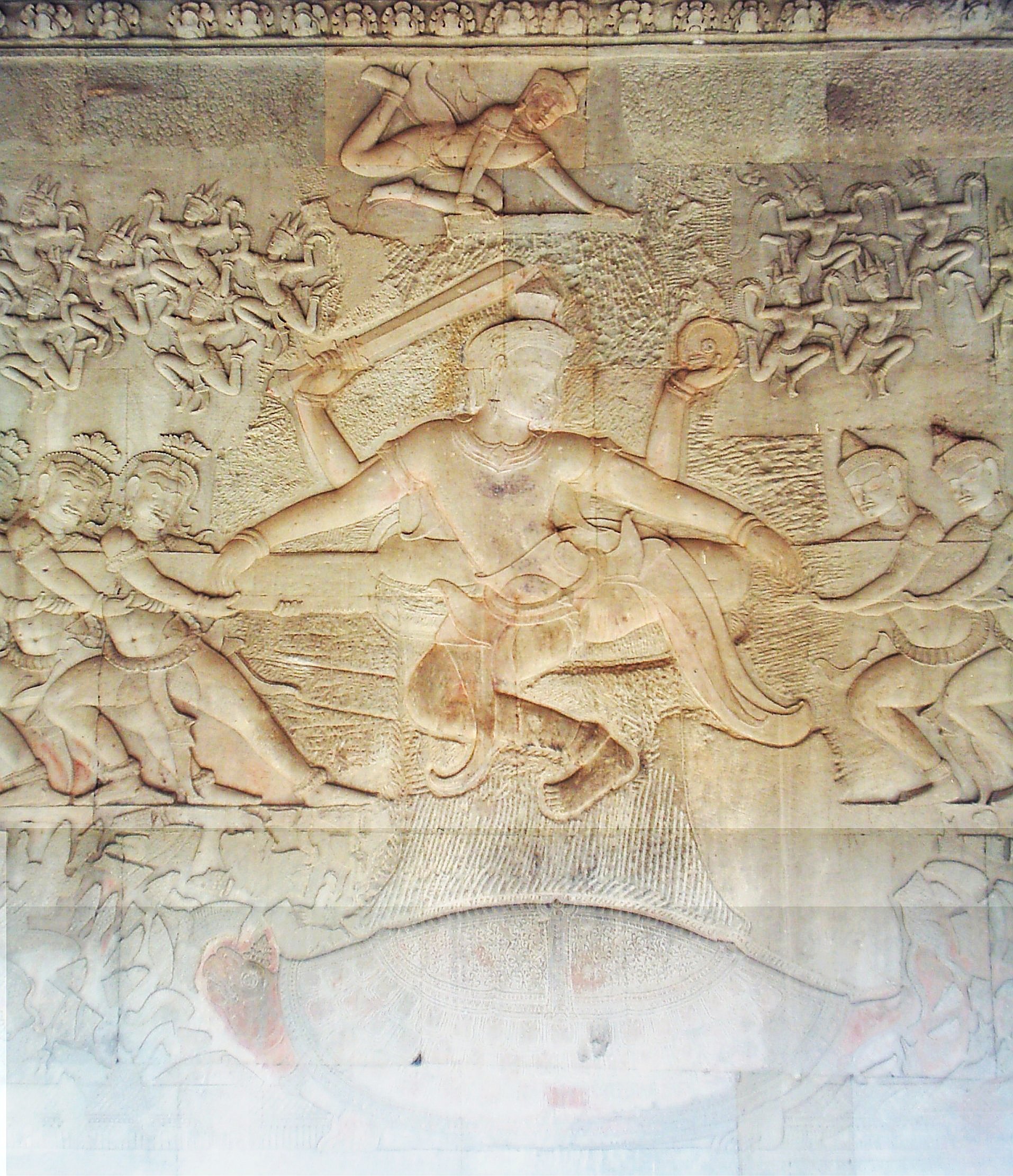
The top has a Gold embossed dancing pose. It could be the classical Cambodian depiction of vishnu as seen in the famed Angkor panels


The Angkor panel for comparison

But without attributes it is very difficult to be sure and the locals call this a Sivan temple.

We finished the tour with a wonderful time at the temple nearby with the priest giving us a service straight from any temple in Tamil Nadu for his Aadhi Vinayagar and Tripurasundari

Dont miss the excellent services of Mr. Dhani Hariadi

PT. TITA PANORAMA INDAH TOURS & TRAVEL

Komplek TanjungPantun Blok P No. 4 Batam Island 29453, Indonesia.
Phone:+62 (778) 3306999
Fax: +62 (778) 456 797
Mobile Number: (+62) 81372788887

Some Macabre attributes !

To even try to comprehend Hindusim, let alone setting off to understand it, is a task that many dread to attempt and few have succeeded. The evolutionary tales of this unique religion is lost in pre history and the trails n tribulations of a continent in constant churn. The vestigial remains of its early forms are a distant reminder of its yet unclear origins and when many western scholars first sampled the religious art , their initial impression was not palatable as per their set canons. Have seen many arguments risen subsequently wherein with a wider exposure, the first reactions have watered down and the art has been appreciated more though questions on the religion still persist. To be honest and fair, to someone who is not exposed to the zillion things that one got to know about the Hindu pantheon – the fanged gods, chopped heads, gory depictions of religious self sacrifice, demons impaled on lances, a garland of skulls, an infant fetus as an ear ring, ‘naked’ Gods etc do present a picture that is not pretty.

It is hardly surprising that to even to someone who has been brought up amidst its folds, the cult of Shiva especially, presents a very difficult and complex question – a seemingly paradoxical representation of God – the Destroyer, the one who lives near the abode of the dead, surrounded by Ghosts and goblins as his assistants, smeared with the ash of burnt bodies. That much for his anthropomorphic form, to talk of his ‘other’ slightly darker followers – the Kalamukas, Kabalikas , Pasupathas, Kaulas, of his fiery Bairava forms and then to the more popular manifestation as the Linga, has spawned another stream of contradicting arguments.

To add to the above, I am trying to present a few more to fan the fire of arguments, for that is the beauty of this religion which does allow one to question the very essence of its core !

Apart from the tales and legends, a few vestigial attributes seem to attest to the notion constant evolutionary nature of Hindusim. Thanks to Late Sri. Ganapathi Stapathi’s wonderful work – Indian Sculpture and Iconography for showing us that the creative tradition kept alive these subtle concepts to this day.

We see below an intricate sculpture of Bairava form of Shiva from Halebidu, the heights of Hoysala art, every inch is intricately carved.

Hoysala art is truly a problem of too many and majority of today’s tourists would rush past without even a second glance due to the profusion of art on display and maybe to the call of the horn of the tourist operator’s hurried itinerary bound luxury coach driver. Even for the few who do stop and look, the attribute held in his left hand is truly macabre.

It was with a certain trepidation that I decided to look it up in the book and was surprised to see it listed.

Quote:

” Katvangam: This is a staff fashioned out of the leg or thigh bone, on which a skull has been fixed. A snake, coiled around the staff, emerges with its hood raised from one of the eye sockets. This implement is similar to the mace, and, instead of the thigh bone, the staff maybe made of wood. Usually an accessory of Kapalika Shivaite images, the Katvanga is also an instrument of Shiva. sometimes, it can also be adopted as a staff for Yogis or rishis. The staff should be 2 face lengths high and 2 viral thick: the skull should be 5 viral wide and 7 viral long.'”

Not only was the description apt but the illustration was picture perfect. Thanks to our artist Raghavendra Prasad for rendering it clearly for us

While we were discussing this, our good friend and fellow heritage enthusiast and expert Photographer Swami came up with another gem and kudos to him for spotting this. A Brahma from Somnathpur

The question was the attribute held in Brahma’s right hand.

Thanks again to Prasad.

Being the destined ‘ Creator’ to find him with this ‘weird’ implement was baffling. Back to the book again.

Quote:

“Siruk, Suruvam: These ladles or large spoons are considered to be Brahma’s instruments. They are used to pour oblation ( ghee) into the sacrificial fire. On the final day of the yagna or sacrificial rite, the ladle is used to pour various oblations into the sacrificial fire in a ceremony known as purnahuti. The siruk is made of wood and is shaped like an ordinary spoon. The suruvam has a square, box-like scoop, adorned with a cow, elephant or other such animal head at its extremity. The length of the ladle may be taken as one muzham or cubit.

Since Brahma is considered to be the symbolic priest or chief for the sacrificial rite, these ladles represent Brahma in his Vedic identity. Further, the ladles are symbols of the rite itself.”

Quite interesting depiction and lot of questions emanating out of it. But first to set out to find a Suruvam with an Elephant head !

A Chola Pandya Temple in Cheranmadevi and its secrets – part 2

Secret Chambers, Buried Treasure, Vaults with untold wealth, tunnels that run for hundreds of Kilometers, Kings escaping from inside a granite mandapa – are all stuff of legends. Having been brought up on a healthy dose of fiction, most of us would have dreamed of being in such a situation and no wonder it news & rumors continue to capture the attention of the masses to this day. So when we were given a chance to explore one such within the Bhaktavatsala Permal Temple in Cheranmadevi, it was a dream come true and we literally jumped in.

It is quite true that most ancient temples did have some sort of secret chamber to protect their wealth, not just to hold their treasures – that they had in plenty as not only Kings, but chieftains and the rich, showered them with gifts. These the temple utilised as a kind of village bank lending money and collecting interests. It also helped that despite frequent wars among the kings, temples were relatively insulated from pillage till the advent of Gazhni upnorth and Allaudin Khilji down south. These chambers then became the refuge for the Gods themselves, as they were the easiest to hide the movable deities

For more interesting reading check this from Dr. R. Nagasamy – Underground Secret Treasuries in Ancient Temples

The last para is quite hair raising...” Lastly the late T. G. Aravamudan, the noted numismatist, and the author of ‘Portrait Sculpture in South India’ narrated to this author on more then one occasion, his experience in the Great temple of Tanjore, In his young age, he was once taken blind folded, through an underground passage in the Great temple of Tanjore. When he reached the secret chamber and his eyes opened, he found a large number of Chola bronzes of exqusite beauty stored there. He was able to recollect that the passage through which he went seemed to be between two granite walls. Later he made several attempts to locate the entrance to the passage in the temple but failed. It is not unlikely that many such underground secret treasure chambers exists but their discovery will remain only a chance find. “

Back to our little secret, the chamber is right underneath the arthamandabam in front of the sanctum

We managed to beat the power situation in the State till then, but then suddenly as we turned away towards the exit, it claimed victory – thereby taking us back in time by many centuries – to understand how it would have looked then – dark.

There right by the site of the door, it would have been impossible to spot in that lighting – but ASI had removed the false stone door and replaced it with a steel hinged one for our benefit.

The layout of the entire contraption was pretty awesome – the door opened to a sheer drop of about 7 feet. about a feet from the bottom, there would have been a false wall – which gave way to a narrow tunnel – just about enough to let me crawl and then it turned right ! Claustrophobic – was the word, am not particularly fond of dark passages and this was pumping my adrenalin rush through the roof.

The small path then opened to a decent shaped room – about 4 feet in height but pretty wide.

It was pretty dark – the powerful flash of the camera and the trusted 3 cell EverReady torch, tried their best to help us out.

With all the excitement of being inside an authentic relic chamber giving us a high, we were a bit disappointed at seeing an empty room, but if only it could tell us its tale !

Sans a Spade, without a crowbar – How to bring down a Temple !

I know. Its a shocking title. But what we are going to see today deserves such ! When we say India is full of innumerable treasures littered around ( literally) – i didn’t know it would be so true. Me and Shankar were scouting for interesting sites in and around Arakkonam in his hired cab when at a distance we spotted a familiar shape. Could it be it?

We screamed at the driver to stop and sprinted across the fields much the disdain of the grazing cows. As we edged closer the colossal structure seemed to take vishwaroopam in front of our very eyes.

A familiar rustle and a shiny tail slithered through the vegetation as we kept walking towards the ” Trees”. The snake must have been bemused as he failed to register anything in us. We were too shocked already to do so.

A magnificent brick temple was being pillaged by nature and humans. Its a testament to the wisdom of the ancient architects that they could build such with just bricks to withstand and stand despite this.

The memory of the slithering snake fresh we edged gingerly to the entrance to view the inside.

How many times have you seen a small innocuous plant growing on top of the temple Vimana or Gopura, How much effort it would take to get a few volunteers to clear and clean them at that stage. Because it was not done see the impact.

The trees are practically splitting the entire temple into two as though driving a wedge into them. Its a pity that such a beautifully designed and constructed brick temple has fallen prey to this due to our gross negligence.

The real loss must be seen to believed. The size of this temple dwarfs the 20foot pole next to it, but then the trees have won this battle.

The villagers ofcourse have no problem, they have floated a new temple ( which was already listing to one side even before consecration) right next to the ailing edifice, painted bright yellow., but no amount of such can erase the responsibility of ours of robbing India of another of its heritage treasure, entombed in vegetation.