Masroor – Was this an inspiration for Angkor Wat

Couple of weeks back, my good friend Mrs. Lakshmi Sharath asked me to do a guest post on her site.
Travel blogs of a backpacker!

My thanks to Lakshmi for asking me write this blog in her site as a guest. After dabbling in many subjects, I finally found my hearts fill in sculpture. The call of this dying art is unique -these images are dormant yet speak volumes, and like learning a new language once your learn their tongue, its sheer poetry in stone.

Since her site was about backpacking and travel, thought I would mix a bit of both in this post – so I introduce you to a little known monument – Masroor.

Call it serendipity, but i was looking for a good picture of the Mahabalipuram test panel when i came across a familiar face – a real stud who turned out to be my buddy from preschool – Albert. We chatted up and promptly in a couple weeks he sent me some pictures of his visit to Himachal Pradesh, to a hither too unheard of place (at least to me) called Masroor.
17811785
What I saw blew me away. The Masroor temple complex is in Himachal Pradesh ( near Kangra – 20kms and Dharamsala – 45 kms. At a distance the sandstone hill doesn’t quite give up it secrets – a late 8th Century rock cut Shiva temple. Hailing from Chennai Rock cut shrines and caves are my particular favorites, not just for their artistic skill but also for their complexity ( need to carved in situ on live rock – top down) – they are many superb examples of this in South India and western India but had not expected something of this scale,size and most importantly the style.
1775177717791783
I am sure all of you have heardof Angkorwat – a 11th Century Cambodian temple complex. What interested me with Masroor is the uncanny resemblance /similarity between these two – complete with the tank in front – beautifully mirroring the structure on top.

http://news.nationalgeographic.com/news/2007/08/photogalleries/Angkor-pictures/
17721785
The relief carvings are amazingly detailed but have borne the brunt of nature, yet my imagination runs wild when I think of how these beauties would have looked when they were sculpted or does the aging adding to their beauty. Angkor got its fame from the overgrowth of vegetation and Angelina Jolie/ Lara Croft, maybe Masroor needs
Priyanka Chopra to do a similar one to gain recognition.

Could this have been the inspiration behind Angkor ?

The devote who wore slippers

1793
Darasuram Airavateshwara temple sculpture, an amazing work of the hunter devotee of shiva, kannapar. We will see his story in more detail later, but one curious aspect of this sculpture attracted me to it. Its a splendid depiction of kannapar, the bow slung on his shoulders, the devotion in his face are brilliantly captured. But as you complete the sweep of the eye, the feet and what he wears on them startles you – a pair of lovely sandals.
1796
Normally one would refrain from wearing footwear inside Indian temples and so too are the sculptures inside, atleast the majority of them, the exceptions being shiva as the charming ascetic – shiva bhikshadhana and kannappar. Why is he depicted wearing these sandals? to answer that we need to go back to fourth thirumurai ( thanks to Mr. V. Subramanian again for giving me this verse reference)

http://www.thevaaram.org/thirumurai_1/songview.php?thiru=4&Song_idField=40490&padhi=049&startLimit=7&limitPerPage=1&sortBy=&sortOrder=DESC

In short, the ardent devotee kannapar, guarding the shrine of shiva with his bow and arrow on one hand, the cooked meat ( we will see this too later) on the other hand, wearing a large slipper made of animal hide….( and so goes the description)
1789
Now you see how intricately the sculptor has characterised each subject he worked on down to last detail.

Images courtesy

http://www.kumbakonam.info/kumbakonam/darsuam/

A historical graffiti

My friend Lakshmi’s blog post on graffiti below reminded me of my earlier post in mintamil forum on such acts of vandalism.

http://backpakker.blogspot.com/2008/09/india-through-my-eyes_21.html

April 1819, John smith, a Captain from the Madras regiment, with his mates was hunting tigers in the forests. He came across a horse shoe shaped canyon with many caves – yes, he is the one who is credited with rediscovering Ajanta ( how could such a marvel ever get to be forgotten !!)

Admiring the marvelous creations there, he went on to inscribe his signature along with the date on the fresco painting. you can still see it there.
17471749
Yes, this made him immortal along with the paintings.

Maybe, our friends ( tanjore mani ?) consider their exploits to be parallel to the great accomplishments of our kings who conquered far off lands, and etched their praise in stone, and hence scribble their names on this magnificent creations!
17411745
This amazing wall panel of Gangai konda cholapuram has not been spared from the wanton acts of these people, who have little respect for the cultural heritage of the land they hail from, the greatness of these works. Let us try and educate these people to learn to respect art.

Back from the Crocodile’s belly

In an earlier post we saw how Hanuman came out alive from a Crocodile’s belly. Now, we are going to see another such feat.

Darasuram has some amazing miniature story board like freezes. One such depicts the Periapuranam legend of Saint Sundarar, by his infinite devotion to Lord Shiva, making a crocodile regurgitate a boy.
1640
The story goes thus, in the town of Avinashi, two young boys, close friends just completing their 5th year, go for a swim in a nearby lake. Unfortunately a large crocodile swallows one of the boys, while the other manages to escape and return home. The loss of their dear son greatly grieved the parents and they never managed to get over the grief.

Couple of years pass and the other boy is old enough for his thread ceremony, so his family prepares for it in great fanfare, a festival atmosphere prevails with beating of the ceremonial drums etc. On seeing this the parents who had lost their young child, are reminded that if not for the unfortunate incident, their home would also be bedecked and resound with similar joy and celebrations. So great was their loss that years couldn’t lessen their lament.

To their good fortune. the great saint Sundarar had taken an invitation from his dear friend Cheraman Perumal to see him in tiruvelam. so as he was moving there from thiruvaroor, he passed through Avinashi. As he was passing the street, he heard laughter, rejoicing and all auspicious sounds from one house and from the other house he heard the heart wrenching lament. he inquired around and learnt the story of the two boys. Just then the weeping parents heard that the great saint was passing by, and they wiped their tears and being true devotees of shiva, offered their respects to him. Moved by their devotion and wanting to alleviate their suffering, the saint decided that he would resurrect their son and then only worship the god in the town’s temple. So he composed his divine verse right there, imploring the Lord – who loves his worshipers, he who dwells eternally in the minds of his followers,
he who is the start and end point of all, he who resides in this beautiful town of avinashi, please bring forth the boy on this tank bund.
16371642
Lo and behold there came the crocodile and regurgitated the boy, much to the delight of his parents and all around. Thus is the grace of the lord and his benevolence to his followers.

Thanks to Mr. V. Subramanian, for his valuable guidance with regard to the verse references.
http://www.geocities.com/nayanmars

A stone chain, bears a flower, to attract parrots

Thanks to my friend Mr. Chandrachoodan Gopalakrishnan ( who goes by the screen names ravages) got inspired to do part 2 of this amazing stone chain.
173517331737
Came across a similar interesting work in Thalakkad. Thalakkad has some interesting legends and even more interesting sculptures. But today we are just admiring chains, in stone. Just look at the complexity of this creation – a single block of stone ceiling, carved delicately to show the mesmerizing curves of a four headed serpent spreading its hood and from its gentle swaying curve start a chain of stone.
1728
But then, when we saw the Kanchipuram Varadaraja Swamy temple stone chain – we stopped short – for the sculptor not content at just sculpting a chain of stone, linked to the stone ceiling ( single piece) and not wanting to stop at that _ kind of a attempting to better your world record jump by attempting the impossible – literally goes for broke,a crowing stroke to forever leave his mark on his creation. Take a bow my unknown master sculpture, for who else can even think of attempting such. It drives me mad, how could he even try something as audacious as this .. like an artist finishing his painting with a exaggerated swagger, like a talented musician finishing his concert with a master stroke, he finishes his stone chain with a blooming flower bud and four parrots feasting on it.
1731
Oh, man, i got to take a break after this. its mind boggling.

Great escape from a Crocodile’s belly

The story sculpted in this pillar from the Srirangam temple is quite unique. Have not come across similar depictions anywhere else. In order to appreciate this pillar sculpture we got to go and read the Ramayana.

Indrajit,the evil but extremely talented son of Ravana, hurls a magical missile at Laxmana ( Rama’s younger brother). He is mortally wounded and as per expert medical advise sought on the battlefield, the only cure is a rare herb Sanjeevani, that only grows off in a far off mountain. Hanuman jumps across the ocean in search and since he couldn’t identify the specific plant, he uproots the whole hill and brings it back ( refer to the comment by Kathie on the post on Narthamalai)

This story is known to most of us, but what other troubles did he encounter in this trip. This is what is portrayed in this pillar.

Having heard from his spies of Hanuman’s quest for the herb, ravana speedily dispatches one of trusted lieutenants – his uncle Kalameni, a demon to the foot hills of the hill. He disguised as a sage, welcomes Hanuman and since the mountain is very pure, requests him to go take a bath in the nearby pond. ( which is bewitched by a gargantuan crocodile). On stepping into the pond, he is swiftly swallowed by the crocodile. Hanuman uses his strength then to split the crocs belly and emerge, when Lo – the crocodile carcass disappears and there stands a beautiful maiden. She is Dhanyamaali, a heavenly nymph, who was cursed by dhaksha. Having heard all this, hanuman is red with rage that the false sanyaasi who delayed his quest, goes to him, drags him by his hair and kicks him – which launches him into high orbit and he flies and falls dead in the throne room of Ravana.


This is what is being depicted in this pillar. Look closely – to the left you see the sage ( just coming into the picture) pointing to the pond, then you move right to see hanuman emerging from the croc’s belly and then Dhanyamaali thanking him. Switch back to the left, lower panel – you see hanuman dragging the false sage and spanking him.

What an amazing piece of work, such detailing of the crocodile’s body, its feet, the majestic form of the emerging Hanuman ( remember this is part of the same series of pillars which we analyzed is so much detail earlier with regard to the horse rider – this is a similar pillar – you can see the hind legs of the horse coming into frame with its anklets etc)

There is another legend of someone emerging from the belly of a crocodile which is also depicted in sculpture, which we will see in the coming posts.

Art meets engineering – The world’s largest Buddha

We have seen many rock cut shrines and structures in india, but not many outside china know about this magnificent rock cut Buddha – the largest in the world, sitting facing the west, the Giant Buddha is located on the western slope of Xiluan Peak of Lingyun Hill in Leshan.
1545153015501559
The total height of the Buddha is 71 metres (233 feet) tall, the statue depicts a seated Maitreya Buddha with his hands resting on his knees. His shoulders are twenty-eight metres wide and his smallest toenail is large enough to easily accommodate a seated person.
153215391557
It is lofty and massive with a symmetrical scale and with a 10 meter wide head, 5.6 meter long nose, 7 meter long ears, 5.6 meter long nose, 7 meter long ears, 5.6 meter long eyebrows, 3.3 meter long eyes,3.3 meter long mouth, 3 meter long neck, 28 meter wide shoulders and 8.3 meter long fingers, and the height from the Giant Buddha’s insteps to its knees is 28 meters. On its head, there are a total of 1021 hair buns.

Construction was started in AD 713, led by a Chinese monk named Haitong. He hoped that the Buddha would calm the turbulent waters that plagued the shipping vessels travelling down the river. Construction was completed by his disciples ninety years later. Apparently the massive construction resulted in so much stone being removed from the cliff face and deposited into the river below that the currents were indeed altered by the statue, making the waters safe for passing ships.
154115431561
The most amazing aspect of this sculpture is the engineering behind it ( literally) – the area receives abudndant rainfall and inorder to safeguard the Buddha from the effects of flowing water – the top hair buns are so designed to channel the water that falls on his into hidden channels down into holes in his ear and taken to the back of the statue and drained. similarly the water than falls on his body is channeled through canals in his robes skillfully concealed from the back of the Buddha’s neck to its toes. The Buddha rests his feet at the confluence of three rivers, reclines his back on nine hills, overlooks Emei Mountain and dominates the old city, Jiazhou. With a dignified and solemn appearance and grand verve, the Buddha is the largest sitting Stone sculpture of the Maitreya Buddha in the world. ( sadly it been badly scarred by industrial pollution in the recent years)
1548155515521559
1563
The sitting pose and the water in front – kind of remind you, of another site halfway across the globe – Abu simbel and its colossal Statue of Ramses. Quite remarkable despite considering the totally different ideals of the two men, one who renounced everything becoming a God to his followers and the other who coveted every possible possession ( wearing the two crowns of lower and upper Egypt) and called himself God.
15261550

Thirst for Art knows no boundaries – Narthamalai, a guest post

You would have read in the about me section, the yahoo group discussing Kalki’s amazing creation – ponniyin selvan introduced me to host of new friends. One post out of blue in the forum made me stand up and notice ( www.ponniyinselvan.in). A post which was not out of place in a forum that discusses one of the greatest work of historical fiction in the Tamil, but coming from an American woman, it sure raised my eyebrow. Maybe it was one of those pseudo blogger names, so i started a conversation – what unfolded left me dumbfounded. Kathie is an American, who possibly has visited more obscure sites ( including ancient sacred places, even ones without much left at the site) than the celebrated back packer, ardent temple enthusiast in India, not just with an eye to see them as a tourist, but to enjoy the beauty of sculpture, to drink in the true pleasure of stone art at its very best – She has been coming to India since ’86 seeking out spiritual places filled with amazing works of art. So when i was thinking of calling someone to grace this site with a guest post, she agreed instantly. Her enthusiasm is contagious and her knowledge makes me wince!! over to Kathie

One site I’d been longing to see, on the strength of one photo in J.C.Harle’s “Art & Architecture of the Indian Subcontinent”, was NARTTAMALAI [Narthamalai].

Legend tells that its great granite pile fell off the mountain of healing herbs carried by Sri Hanuman, flying down to Lanka. It’s true that the area is known for medicinal wild plants.

Winter ’95, I took a taxi down from Tiruchi into Pudukkottai district, wondering if I could find the place. There was the enormous granite hill with a pool at its south end, but where was the temple ?
1583
Doubtful, I walked along the fairly steep rock-face, noting an Ayyannar shrine across the water; then, through the trees, appeared the beautifully balanced Vimana: Vijayalaya Cholisvara Koil
1586

This temple of 866 CE, built by Muttaraiyars — fiduciaries of the Royal Chozhas — shows that their artisans excelled in both architecture & sculpture. The west-facing temple’s round amalaka still had some paint –a soft red–, with 4 side shrines, gentle Nandi, & two caves in the cliff behind.
Murthis on the temple itself was quite worn and hard to see without binoculars.
To my taste, this is the most perfectly proportioned temple in TN.
1588
The several door guardians here were among the finest I’d ever seen, a platform against the rock had a mala of playful elephants & Yalis, , including one with a human face. There were more loose murthis on the platform.
1591

1609
One cave was being used as a storeroom. The other — Samanar Kudagu, once Jain — had interior walls lined with 18(?) carved Vishnus, each subtly distinct.
15961612
Beside the koil masterpiece, the view east from the temple courtyard– angled rocks and green paddy — was breathtaking.
15981600
in 2007 I visited again with a group of friends. By then the amalaka had lost it’s rosy tint.

This time we continued down the great granite slab slanting to the north, and at its foot, found another Ayyannar Shrine of over a hundred steeds for the village guardians.
1603
A magical place.

There is a newer temple on Narttamalai which we didn’t find.More sculpture from this site can be seen at the Pudukkottai Govt. Museum.

Kathie Brobeck

p.s We will visit this amazing place in more detail in subsequent posts.

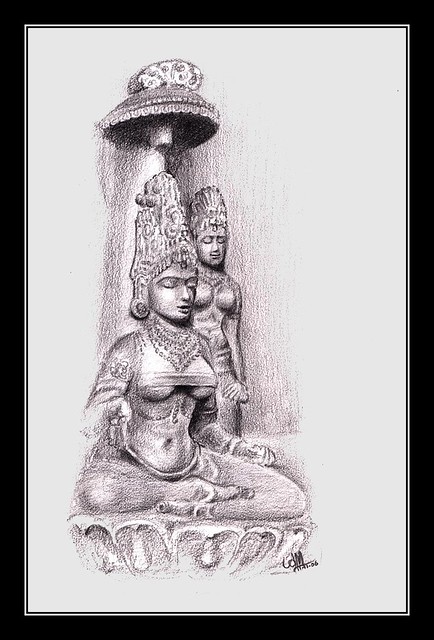
Art inspired by Sculpture – Series – part 2

We had seen earlier how profound is the influence of a divine creation on a viewer. The splendor of the masterpiece, transcends time and the joy of the artist’s creation, despite being a thousand years old, continues to pass on from his flesh to stone and from the stone to flesh – of the viewer.


Not many people are lucky enough to be so enormously talented, to be able to give shape to this feeling. It is a void many feel, when one sees pure beauty in front of your eyes, your mind captures it in its eye and your body is overpowered by this dose of sheer exuberance, you are searching for a medium to release this energy. And if you are as talented as my friend Mr Murali, then all the stored responses gushes forth in a spontaneous burst of creativity – adding luster to the creation, a fitting tribute to the masterpiece. Its not often you get a chance to compare two different art forms, products of two different streams of art – spread over a 1000 years, both masters in their craft

Its easy to see why this creation inspired the artist, though the big temple abounds with such brilliant works in stone, the beauty of this creation, leaves you speechless. The Laxmi ( had earlier posted this wrongly as Gyana Saraswati – on further reading notice that this is Laxmi – has two hands and a breast band – whereas Saraswathi is four armed and misses the breast band – apologise to readers) master sculpture of the tanjore big temple. What perfection, the graceful crossed legged seated position, the calm serene face, those arched brows, the benevolent smile, the jeweled crown, the splendid ornaments, the detailing of the garments, Oh – if only i were a chola sculptor i would have felt that my life’s purpose is attained on creating such a masterpiece. So great is this work, imagine to be able to breathe life into stone and create this divine form.

And despite technology bringing you the best in color photography, black and white is the best – the depth that it lends to the finished product is spectacular.

But for the fingers that sketched it on paper, no words suffice, no praise apt. Hats off to you murali and thanks again for sharing your stuff with us. May you continue your quest in art and bring many more such beauties to life

You can view all his beauties here

Tanjore sculpture

Mallai Shore Temple – An Intro Post

Before i start introducing the shore temple ( does it need introduction?) i got to place on record my sincere thanks to two friends i met on flickr.com – their photography stunned me and when i sought their concurrence to host their pictures here, they gladly agreed. The stunning visuals truly add beauty to the pallava creation and they are from the lenses of Mr. Prabhakaran ( Aadhi arts) and Mr Chandrachoodan Gopalakrishnan ( Ravages)
1570
Any chennaite and every visitor to Chennai – takes back many interesting memories, but nothing as spectacular as the twin spires of the shore temple.
15671576
By the lilting waves of the sea shore, landscaping the skyline, words cannot aptly explain the visual overflow of senses on seeing this magnificent edifice, standing tall for a 1300 years, withstanding the elements, a living tribute to the pinnacle of artistic excellence of the Pallavas. In Art school you are taught the elements of symmetry and how aesthetic beauty comes from symmetric images – you could base the straight profile for that argument, but the greatness of this creation is that the asymmetric towers too appeal very much to your senses.
1579
The structure most often serves the purpose of a photo backdrop and not many know the intricate details of the structure, which is the purpose of this introduction.

The mallai shore temple is actually a three in one temple – an earlier Vishnu shrine
sandwiched inbetween two shiva shrines. The two Shiva shrines
gopurams are built by the great Raja Simha Pallava ( the self styled king of unlimited fantasies – Atyantakama – you can see his trade mark prancing lion pillars – we did see them earlier in the Saluvankuppam post – tiger cave bordering the stage and you will see more of them when we venture to Kanchipuram for his grandest creation – the Kanchi Kailaasanatha temple ). The Vishnu shrine in between, did it have a tower or was it damaged later, is not clear.
1574
But there are references in Vaishanvite Saints ( Alwars) works of Kadalmallai
Talasayana perumal. In Rajaraja’s later inscriptions he mentions the names of the three shrines of at Kshatriyasimha Pallavesvaragriham, Rajasimha Pallavesvaragriham and Pallikondaruliya Devar shrine.
Kshtriyasimha and Rajasimha are ofcourse titles of Rajasimha himself and hence we can conclude that these shiva shrines were built by him.

The shore temple is truly an ode to sculpture
1572

We will see more of the Sthala Sayana, the Vishnu shrine in the coming posts.