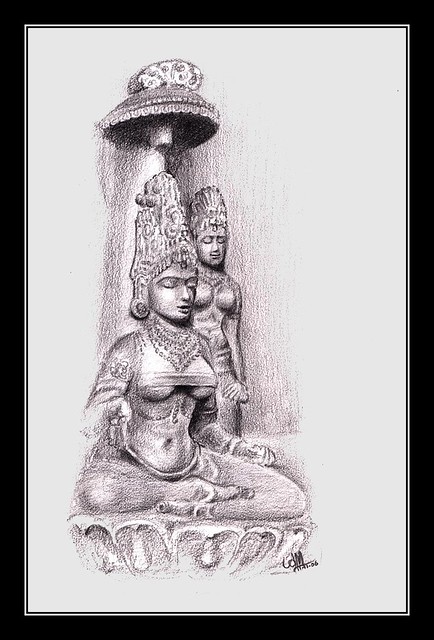
We saw earlier how the the amazing pillars of Srirangam Sesharaya Mandabam inspired our friends to sketch them. But a casual conversation with one of the young artists, Mr. Prasad, sent me to look for the master artist, who forever immortalised sketching sculpture. I was delighted to see that he too sketched these amazing pillars – He is none other than Artist Silpi (1919 – 1983) – P.M. Sreenivasan.
While Prasad was languishing that he had searched everywhere to see the face of this amazing artist, i remembered our Gokul’s article in Varalaaru.com. For a wider audience i am trying to translate it into English, so that the fame of this divinely gifted artist can spread more.
Lets first see his amazing sketch of the pillars.


Temple : Srirangam Sri Ranganathaswami Temple – Trichy, Tamilnadu, India
Location : Sesharayar Mandapa
Features : The mandapa is finely sculpted with various figures. Silpi captures the essence of this complicated and delicate sculpture
Collection sent by : Prof.S.Swaminathan
Original series : Thennatuch Chelvangal
Magazine courtesy : Ananda Vikatan
Sources:
http://www.varalaaru.com/default.asp?articleid=443
http://www.varalaaru.com/default.asp?articleid=561
Article original source from Tanjore Big temple consecration commemorative edition 1997
The fame of those who are born with divine gifts never fade, so too can’t termites destroy the names of those who strive tirelessly. The noblest of intentions seek out the very pinnacle of beauty and the strive for excellence is akin to a penance. The unbent spine, the unaided eyes ( without spectacles to assist), the steadfast gaze, crowned with the essence of benevolent grace, the gifted fingers that let dance the amazing brush strokes to give life to every stroke. The gentlest of smiles breaking through, not a full fledged laugh but those lips do not part yet you know the joy radiating from the poise. The wide forehead displaying proudly the ash marks of shiva and inbetween the large vermilion mark.

These are the marks of a master artist – Silpi. No stone has been left unsketched by his mastery, in every nook and corner of tamil nadu, itself dotted with thousands of temples. He converted every home into a temple or brought the temple to the homes of the masses, by his divine creations.
He was born in Namakkal in 1919. He was named Sreenivasan. From his young age, he displayed amazing affliction to sketching, more than his studies. The National poet Sri Namakkal Ramalingam Pillai, was a renowned artist as well and seeing the gift in Sreenivasan, he advised him to join the Madras Art college in Egmore, to refine his skills.
He joined for a 6 year course, but his abundant talent led the College Principal Sri. D.P. Roy Choudry to grade him from second year to fourth year straight away. He excelled in pen and ink line sketches. His sketches caught the eye of all and sundry including Mr. Choudry. He complimented the work, keeping it on par if not higher levels of european masters.
when Sreenivasan was a student, he was inspired by artist Maali’s caricatures. Similarly, during later years, Sreenivasan;s works attracted Maali. This bond later got and kept Sreenivasan, in the employment of the tamil Magazine anantha Vikadan for 22 years.
Sreenivasan was more inclined to sketch buildings than human figures, and Mali wanting to take full advantage of this, gave him the name Silpi and commissioned him to sketch temple sculpture.
The divine stone sculptures are not only three dimensional creations, but also have a fouth dimension – the confluence of divinity. Photographs of these sculptures are but images or replicas, but inorder for the true expression of the sculpture to be brought forth, was a task which only the great master artist Silpi could do.
He could portray the divine beauty of the sculpture and capture it into his art. How and when he did it is interesting as well. He would wait for all the devotees to finish their darshan, late into the night and then he would sit facing the deity in the dull light shed by the flickering wicker lamp. Yet he could brilliantly capture the depth and texture of every chisel mark of the sculpture. Once when asked how he could do it, he said ” i only get the right mix of paints, then its the work of the deity who converges with my fingers to sketch itself. Its the work of the master of all creation, i am but a tool”

Before sketching the main deity, he would first sketch the ornaments on a separate sheet. Similarly also note down the colors of the individual gems. After that, as he completes sketching the main deity, he would draw on the ornaments and it would give him great pleasure, as though he is anointing the actual deity with the jewels. This divine bliss is what translated into his creations, which live on for us to feel everytime we see his creations. After completing his sketches, he would dutifully take it to seek the blessings of the Acharya at kaanchi ( the eldest pontiff – now no more – a true saint) – and then bring them home to do special pooja to them. Such was the reverence he had for his work.
After leaving Ananda Vikatan, Silpi’s illustrations graced the pages of Bhavans Journal, tamil magazines like Kalai Magal, Thinamani Kathir, Idayam Pesugirathu, Amuthsurabi, showcasing the beauty of South Indian temple sculpture.
Silpi had a small family, he was ably supported by his wife Mrs. Padma. A lean figure, but always smiling graceful lady, she was the goddess Annapoorani herself when it came to hospitality for her guests. However, ill health took its toll at a very young age and she departed in 1968, leaving behind a son – Maali an daughter Saradha.
For long years, Silpi never groomed a successor. However in 1981, on a January14th – a monday, the day of the harvest festival – Pongal, a young lad of 15 years came with his father to visit Silpi. His name was Giridharan.Silpi was taken aback when he saw the young boys art, complimenting him that at such an young age, even he couldnt sketch such amazing art. Such praise flowed from the masters heart.
He took him immediately as his art successor, and was overjoyed at it. He used a part of his name and his wifes and gave him a new name – Padmavaasan. mr. Padmavaasan went on to become a brilliant artist, illustrating the new editions of kalki’s immortal works of historical fiction. The divinity that flows through his works are reminiscences of Silpi.
Such a masterful artist was not aplty decorated during his lifetime. The coming generation should not forget the contributions of this great artist.
But what is the current status of this amazing pillared sesharaya mandabam…will see next